USPS Notice 67 — Automation Letter Spec & Artwork Checker
Verify your letter-size mailpiece meets USPS automation standards. Upload your print-ready PDF to check dimensions against DMM 101.1.2. Your file never leaves the browser.
Artwork Checker
Upload page 1 of your print-ready PDF. We read dimensions locally in your browser using PDF.js and run size checks against USPS DMM 101.1.2 — height, length, and aspect ratio.
What Is USPS Notice 67?
Notice 67 is the USPS Automation Letters Template — a physical plastic overlay gauge distributed by USPS Business Mail Entry Units (BMEUs) at no charge. Mailers, printers, and graphic designers use it to verify that a letter-size piece meets USPS automation compatibility requirements before it goes to press.
The template lays on top of the piece and shows four critical zones: where the delivery address must be placed (the OCR read area), what area must be kept clear for the barcode (the IMb clear zone), where the FIM pattern goes, and character height gauges for font compliance. A piece that fails any of these zones gets kicked out of the automation line — either manually sorted at a higher rate or returned to the mailer.
In 28 years of running bulk mail campaigns for businesses across Ulster, Orange, and Dutchess counties, Cornerstone Services has reviewed thousands of client artwork files against Notice 67 standards. The most common failure is an address block placed too high — the designer centered it visually, but it sits above the OCR read area. The second most common: a photo or dark background bleeds into the barcode clear zone.
Graphic designers
Setting up letter templates, positioning address blocks and indicias, confirming font heights before sending to print.
Print houses & lettershops
Pre-press compliance review before imposition — catching address placement issues before plates are made.
Direct mailers
Verifying piece dimensions and zone clearance before dropping at the BMEU — a rejection at the dock is a two-week setback.
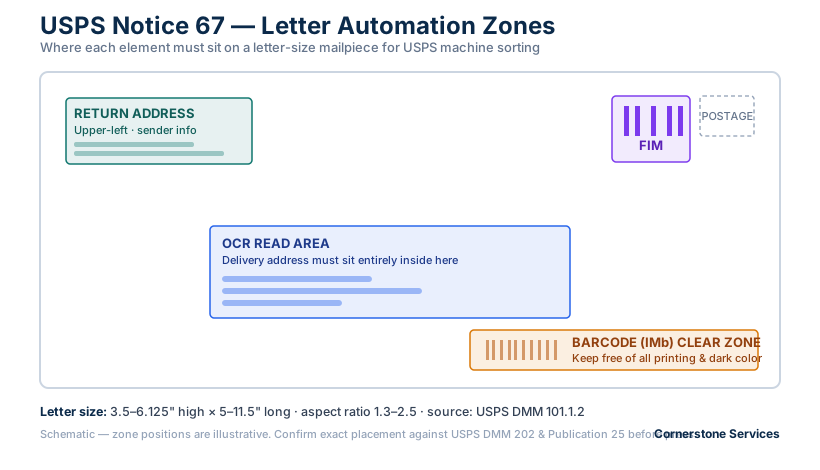
The Four Notice 67 Zones
OCR Read Area — delivery address must be here
USPS optical character recognition equipment scans a defined zone on the address side for the delivery address. Your address block must fall entirely within this area for the piece to be sorted by machine.
From bottom: 0.625" to 2.75" ~
From each side: 0.5"
Source: Publication 25 §2 / DMM 202.3.2
Barcode Clear Zone — must be free of all printing
The Intelligent Mail Barcode (IMb) is printed in the lower-right strip of the piece — either by your mail house or by USPS equipment. This area must be completely clear of background images, dark colors, and design elements. A barcode printed over artwork fails to scan.
Bottom strip: 0" to 0.625" from bottom
From right edge: 0.5" extending 4.75" left ~
Source: DMM 202.5 / Publication 25 §2.4
FIM Location — upper right, applied by mail house
The Facing Identification Mark (FIM) is a pattern of vertical bars in the upper-right corner that tells USPS automation equipment which side is the address side and what mail class it is. FIM-C is standard for permit mail. Your mail house applies it — designers must reserve this area clear.
From top: 0.125", height: 0.5" ~
From right edge: 0.5", width reserved: 1.25" ~
Source: DMM 202.4.1 — width is conservative clearance, not exact DMM bound
Return Address Area — upper left, conventional placement
The return address goes in the upper-left of the address side. USPS does not define a hard boundary for return address position, but it must be clearly readable and above the delivery address. Upper-left quadrant is the accepted convention (Publication 25 §1.1).
Shown zone is conventional — not a USPS-specified hard boundary ~
Piece Size Requirements
Source: USPS DMM 101.1.2. All dimensions in inches. "Length" = longer dimension; "Height" = shorter dimension. ~ = approximate or pending exact source confirmation.
Letter-size mail
DMM 101.1.2 — Marketing Mail & First-Class
| Dimension | Min | Max |
|---|---|---|
| Height | 3.5" | 6.125" |
| Length | 5" | 11.5" |
| Thickness | 0.007" | 0.25" |
| Aspect ratio (L÷H) | 1.3 | 2.5 |
| Max weight | 3.5 oz | |
Postcard
DMM 101.1.2 — First-Class & Marketing Mail
| Dimension | Min | Max |
|---|---|---|
| Height | 3.5" | 4.25" |
| Length | 5" | 6" |
| Thickness | 0.007" | 0.016" |
| Aspect ratio: same 1.3–2.5 rule applies | ||
Pieces outside letter-size limits are classified as flats (max 12"×15") or parcels, each with different rates and automation rules. Pieces within letter size but failing aspect ratio or thickness are assessed a non-machinable surcharge — currently $0.41 per piece (First-Class, 2026 rates).
Get the physical Notice 67 template
The physical plastic overlay gauge is available at no charge from your USPS Business Mail Entry Unit (BMEU). In the Hudson Valley, the Mid-Hudson BMEU in Newburgh, NY serves Ulster, Orange, and Dutchess county mailers. Call ahead before visiting — BMEU hours and template availability can vary.
Official USPS Resources
USPS Publication 25 — Designing Letter and Reply Mail
The definitive USPS guide to letter-mail design standards. Includes zone diagrams, size tables, and automation compatibility requirements.
USPS Mailpiece Design Analyst Resources
FAQ and downloadable resources from the USPS Mailpiece Design team, including Notice 67 and other templates.
USPS DMM 101 — Physical Standards for Automation Letters
Domestic Mail Manual section covering size, weight, and shape standards for letter-class mailpieces. Source for this page's spec tables.
USPS Notice 67 — PDF version (pe.usps.com)
Official PDF version of the Notice 67 automation letter template. Use this to verify zone positions against your artwork.
Frequently Asked Questions
What is USPS Notice 67?
USPS Notice 67 is a physical plastic overlay gauge that mailers, printers, and graphic designers use to verify that a letter-size mailpiece meets USPS automation compatibility standards. It overlays on the piece and shows the four critical zones: the OCR read area (where the delivery address must be placed), the barcode clear zone (reserved for the Intelligent Mail Barcode), the FIM location (Facing Identification Mark, used by mail processing equipment), and character/size gauges for font height compliance. Notice 67 is distributed by USPS Business Mail Entry Units (BMEUs) at no charge.
What are the minimum and maximum sizes for a USPS letter?
A USPS letter must be at least 3.5" tall and 5" long (minimum), and no more than 6.125" tall and 11.5" long (maximum). Thickness must be between 0.007" and 0.25". The aspect ratio — length divided by height — must fall between 1.3 and 2.5. Pieces outside these dimensions are either non-machinable (subject to a surcharge) or classified as flats. All standards are sourced from DMM 101.1.2.
What is the OCR read area on a letter-size mailpiece?
The OCR (Optical Character Recognition) read area is the zone on the address side of the piece where the delivery address must be placed for USPS automation equipment to scan it. It runs from 5/8" above the bottom edge of the piece to approximately 2.75" from the bottom, and from 1/2" from each side edge. Placing the delivery address outside this zone — too high, too far left, or too close to the bottom — causes the piece to miss automation scans and may result in manual handling surcharges or delivery delays.
What is the barcode clear zone?
The barcode clear zone is the strip along the bottom-right of the mailpiece where the USPS Intelligent Mail Barcode (IMb) is printed — either by the mailer's mail house or by USPS processing equipment. This zone must be clear of all background printing, photos, and design elements except the barcode itself. The clear zone runs approximately 5/8" up from the bottom edge across 4.75" from the right edge. Printing over the barcode zone is one of the most common reasons pieces fail automation sorting.
What is a FIM pattern and where does it go?
A FIM (Facing Identification Mark) is a series of vertical bars printed in the upper-right area of the address side. USPS automation equipment uses the FIM to orient incoming mail — it tells the machine which side is the address side and what mail class the piece is. FIM-A is used for courtesy reply mail; FIM-C for metered and permit mail; FIM-D for business reply mail. The FIM must be placed in the upper-right corner within 1/8" from the top edge and no more than about 1.75" from the right edge. Your mail house applies the FIM — designers must reserve that area.
Where do I get a physical USPS Notice 67 template?
Physical Notice 67 plastic templates are available at no charge from your nearest USPS Business Mail Entry Unit (BMEU). In the Hudson Valley, the Mid-Hudson BMEU in Newburgh, NY serves Ulster, Orange, and Dutchess county mailers. Call ahead before visiting — BMEU hours and availability can change. Cornerstone Services can also provide guidance on automation compliance as part of our pre-press services.
What happens if my mailpiece fails automation standards?
A piece that fails automation standards — wrong size, address outside the OCR read area, barcode zone covered, or missing FIM — can be assessed a non-automation surcharge, rejected at the BMEU, or sorted manually at a higher postage rate. For Marketing Mail, the difference between automation rates and non-automation rates can be $0.05–$0.10 per piece — significant on a 10,000-piece campaign. Catching these issues before production is why pre-press review matters.
What is the aspect ratio rule for USPS letter mail?
The USPS requires that all letter-size mail have an aspect ratio — length divided by height — between 1.3 and 2.5 (DMM 101.1.2). A perfectly square piece (1:1) fails this test and is non-machinable. A very elongated piece over 2.5:1 also fails. For example: a 6" × 4" piece has a ratio of 1.5 — passes. A 10" × 4" piece has a ratio of 2.5 — just passes. A 3.5" × 3.5" square fails (ratio = 1.0). The checker above calculates this automatically from your PDF dimensions.

Sean Griffin — President, Cornerstone Services, Inc.
Saugerties, NY · Since 1998 · BBB A+
This reference and tool is maintained by Cornerstone Services. Spec values are sourced directly from DMM 101.1.2, DMM 202, and USPS Publication 25 — not approximated from competitor pages. Last updated: .
Ready to Start Your Next Mailing?
Get a free estimate from Hudson Valley's most trusted direct mail team. 2.3M+ pieces mailed and counting.